Media kit
Press kit · Shujaatali Badami
Pre-cleared quotes, bios, headshots, and past appearances for journalists, producers, and editors on deadline.
Currently accepting media inquiries · typical reply 4-8 hours US Central
Media kit (one-stop bundle)
Bios in three lengths, name pronunciation, five quote cards, full BibTeX, topic positions. Browse the web version or download the zip.
Browse media kit → Download media-kit.zip Name and spelling →
Topics I can speak to authoritatively
- Post-quantum cryptography migration, NIST PQC standards (Kyber/ML-KEM, Dilithium/ML-DSA, SPHINCS+/SLH-DSA), Falcon, hybrid deployments, harvest-now-decrypt-later threat model
- ICS / SCADA quantum-era security, ISA/IEC 62443, OT lifecycle constraints, gateway architectures, anomaly detection on SWaT/HAI testbeds
- IoT cryptographic standards, IETF LAKE PQ-EDHOC, OSCORE, oneM2M, lightweight authenticated key exchange for constrained devices
- Quantum kernel methods on NISQ hardware, ZZFeatureMap, IBM ibm_fez (156-qubit), QSVM, cross-testbed validation
- Critical infrastructure protection, Purdue model, Zone-and-Conduit, smart-grid security, smart-meter PQC
- 6G cognitive radio security, deep RL under partial observability, energy-aware reward shaping, policy-level attack surfaces
Topics I won't claim expertise on
- Consumer crypto wallets, blockchain trading strategies, or token economics
- Generative-AI policy debates and AI-safety alignment philosophy
- Quantum-supremacy hype claims (I will analyze, not advocate)
- Smart-contract auditing or DeFi protocol security
Ready-to-quote paragraphs (pre-cleared, attribute as Shujaatali Badami)
Harvest-now-decrypt-later
The harvest-now-decrypt-later threat is not theoretical. Adversaries are already storing encrypted traffic from grid SCADA networks today, betting they will have a cryptographically-relevant quantum computer in 10 years. Every utility that has not started its PQC migration is donating data to that bet.
Why ICS migration is harder than TLS migration
TLS migration is a software problem with a fast feedback loop. ICS migration is a hardware-and-procurement problem stretched across 20-year asset lifecycles, regulated change windows, and vendors who cannot patch firmware in field. The threat models look similar, the implementation timelines are an order of magnitude apart.
What ZZFeatureMap is doing on NISQ
An 8-qubit ZZFeatureMap is doing one specific thing: encoding pairwise correlations between process variables in a way that is genuinely hard for classical kernels to capture. On the harder ICS testbed (HAI), that bought us +10.8% AUC over a strong RBF baseline. Whether that survives shot-noise scaling is the next experiment.
NIST PQC migration timeline reality check
NIST CNSA 2.0 calls for PQC adoption in critical infrastructure by 2030-2033. That is a goal, not a forecast. Most utilities cannot complete a single firmware-rotation cycle in that window. The honest planning question is what we deploy in 2026 that is still safe in 2035, not whether we can hit a 2030 milestone.
6G security under partial observability
Cognitive radio is a POMDP. The agent never sees the true spectrum state, just sensed slices. Securing the resulting controller is harder than securing a deterministic radio because the attack surface is the policy itself, not just the protocol stack.
Past media appearances
-
Automation.com (International Society of Automation) · 2026
Exploring Gateway Architectures for Quantum-Safe Industrial Networks ↗
Authored technical article on PQC gateway designs for ICS/SCADA. -
ReversingLabs · 2026
Crypto Group Ushers in Post-Quantum Security ↗
Quoted as expert source on the Ethereum Foundation's PQC initiative. -
TechNewsWorld · 2026
Malware Threats Accelerate Across Critical Infrastructure ↗
Quoted on ICS malware and the FrostyGoop Lviv attack.
Bio (copy-paste)
50 words
Shujaatali Badami is a Quantum-IoT Research Engineer based in Chicago, IEEE Senior Member, ISA Senior Member, and Hackathon Raptors Fellow. He works on post-quantum cryptography for critical infrastructure, contributes to the IETF LAKE PQ-EDHOC Design Team, and serves on the ISA99 (ISA/IEC 62443) standards committee.
150 words
Shujaatali Badami is a Quantum-IoT Research Engineer based in Chicago. He is an IEEE Senior Member, ISA Senior Member, and Hackathon Raptors Fellow, with sole-authored peer-reviewed papers in IEEE Access, IEEE DSIT, IEEE ICPCT, IEEE ICBATS, and IEEE ICEACE.

His IEEE Access 2026 paper validated quantum kernel methods on IBM's 156-qubit ibm_fez NISQ processor, achieving +10.8% AUC over classical SVMs on the HAI industrial control testbed. He contributes to the IETF LAKE Working Group's Post-Quantum EDHOC (PQ-EDHOC) Design Team and the ISA99 Committee that develops ISA/IEC 62443.

He is a Technical Program Committee member for the United Nations ITU Kaleidoscope 2026 (AI for Good Summit, Geneva) and reviews for IEEE Internet of Things Journal, IEEE Trans. Mobile Computing, IEEE Open J. Communications Society, and IEEE Trans. Quantum Engineering. He has judged 100+ AI and deep-tech startups at showcases hosted alongside AWS, Intercom, and Michigan State University.
300 words
Shujaatali Badami is an IEEE Senior Member, ISA (International Society of Automation) Senior Member, Hackathon Raptors Fellow, and Quantum-IoT (QIoT) Research Engineer based in Chicago, Illinois. His research secures next-generation IoT and industrial-control systems against emerging quantum threats through post-quantum cryptography, quantum machine learning on NISQ hardware, energy-efficient VLSI, and 6G cognitive radio.

His IEEE Access 2026 paper presented the first cross-testbed validation of 8-qubit ZZ feature-map quantum kernels on IBM's 156-qubit ibm_fez NISQ processor, achieving a statistically significant AUC gain over classical SVMs (p = 0.003) on SWaT and HAI industrial-control datasets. He has also delivered the first peer-reviewed FIPS 203 (ML-KEM) and FIPS 204 (ML-DSA) implementation on Arduino-class IoT (ATmega328P, 2 KB SRAM) with 136 ms signing latency and 1,850 TPS throughput, directly addressing the NSA CNSA 2.0 migration mandate for embedded systems. Additional sole-authored work covers the quantum bootstrap for microcanonical ensembles, mitigating tails-switching in multi-branch Proof-of-Stake, and the first POMDP algorithm combining heuristic depth compression with Boltzmann sampling.

He contributes to two international standards bodies: the IETF LAKE Working Group's Post-Quantum EDHOC (PQ-EDHOC) Design Team, alongside researchers from Ericsson, MIT Lincoln Laboratory, INRIA, ISI Athens, IIT Delhi, and University of Murcia, and the ISA99 Committee that develops ISA/IEC 62443, the global IACS cybersecurity standard.

He serves on the Technical Program Committee for the United Nations ITU Kaleidoscope 2026 (AI for Good, Geneva), and reviews for IEEE IoT Journal (IF 10.6), Elsevier Future Generation Computer Systems (IF 7.5, invited), IEEE Trans. Mobile Computing (IF 9.2), IEEE Trans. Quantum Engineering (IF 3.9, invited by Argonne National Laboratory), IEEE OJ-COMS, and IEEE Communications Letters.

His work on quantum-safe gateway architectures has been published in Automation.com (ISA), and he has been quoted as an expert source by ReversingLabs and TechNewsWorld. He has judged 100+ deep-tech startups at AWS, Carta, Intercom, OSS4AI, HackwithChicago, and Michigan State University showcases.
Headshots
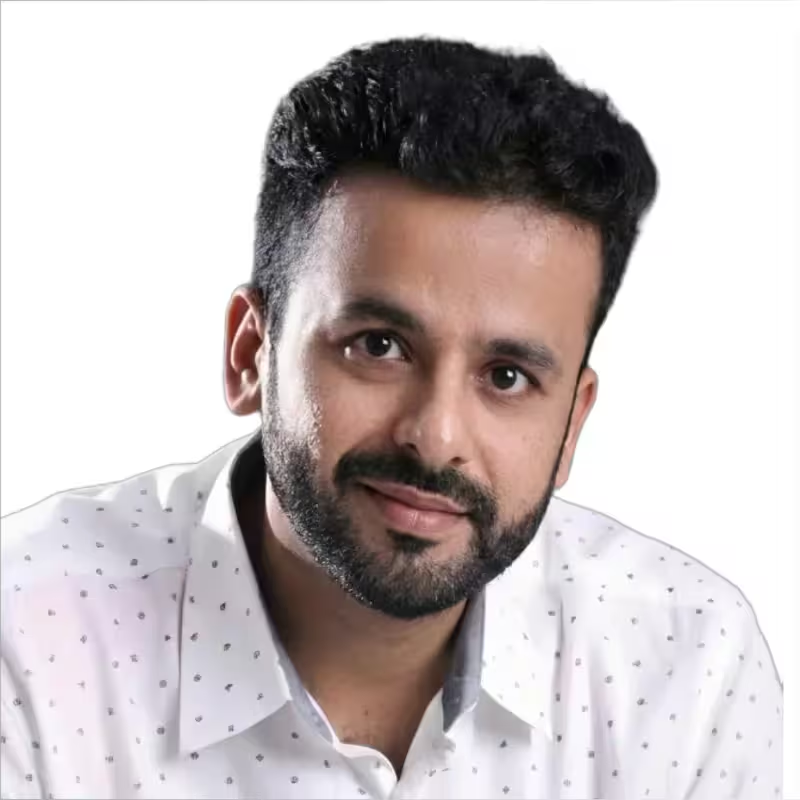
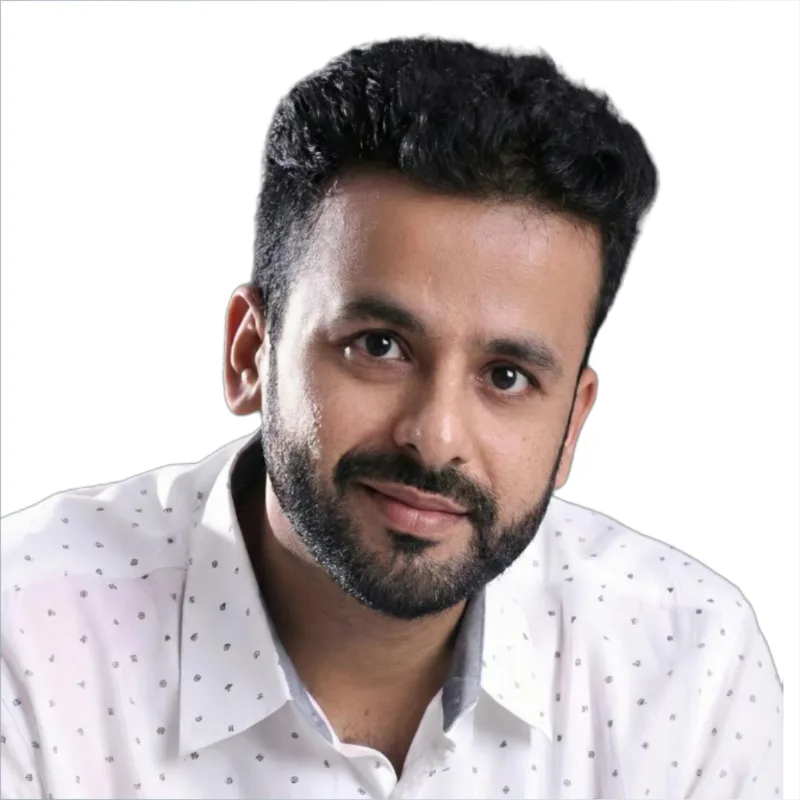
Editorial-use portrait below. Available in AVIF (16 KB), WebP (34 KB), and JPEG (474 KB, original). License: editorial-use only, attribution "© Shujaatali Badami". For higher-resolution / event-specific shots, email with subject [PRESS] Headshot request.
Pronouncer
Phonetic: Shu-jaa-tali Bah-dah-mee /ʃʊ.ˈdʒɑː.tə.li bə.ˈdɑː.miː/. Audio recording will be added, until then this written guide is canonical.